
Dermal Filler or Botox
Which Injectable Treatment Is Right for You?
Choosing between Dermal Filler or Botox can feel overwhelming, but the choice becomes remarkably simple once you understand one core secret:
Dermal filler restores lost volume to plump up deep folds while Botox relaxes muscles to smooth out movement lines.
Both treatments are minimally invasive cosmetic injectables that treats entirely different structural signs of ageing.
This definitive guide breaks down how they work, target areas, longevity, and how they frequently work together to achieve natural-looking rejuvenation.

At-A-Glance: The Core Differences Between Botox or Dermal Filler
For a quick comparison, this breakdown shows exactly how these two powerhouse treatments stack up side-by-side:

What is Botox and How Does it Work?
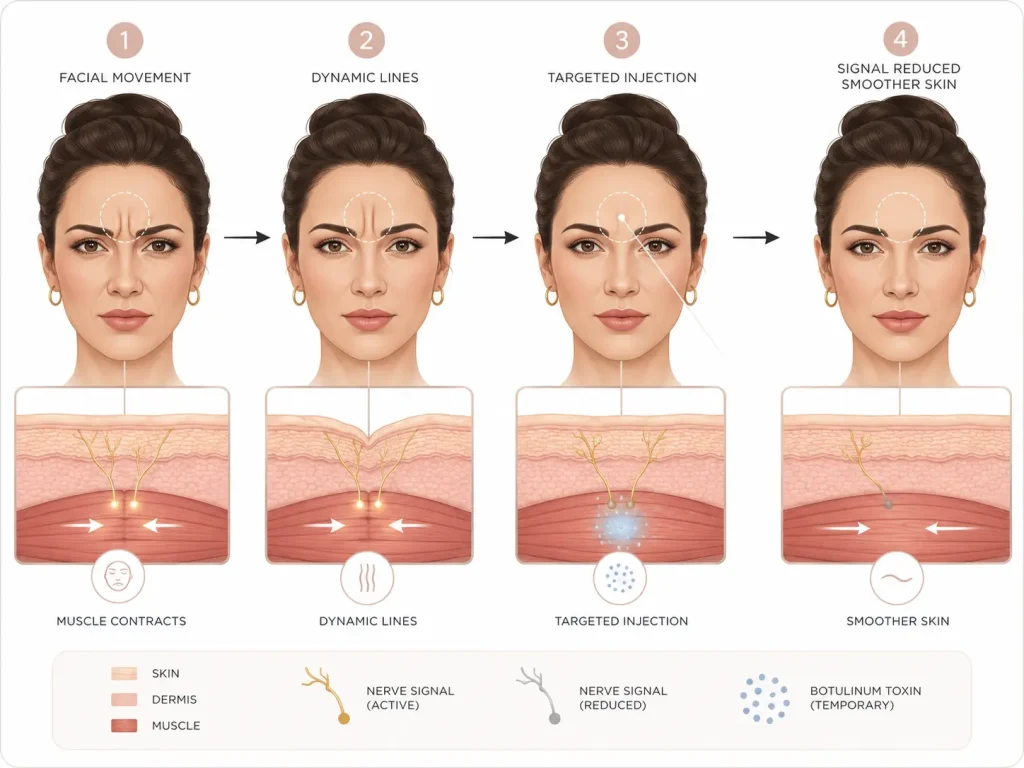
Botox (derived from purified Botulinum toxin) is a prescription medication that acts as a targeted muscle relaxer.
The Mechanism
Every time you smile, frown, or squint, your facial muscles contract, bunching the overlying skin. Over time, these repeated movements create dynamic wrinkles.
When injected in precise, controlled doses, Botox temporarily interrupts the nerve signals directing those specific muscles to contract. By relaxing the underlying muscle, the skin above flattens out, causing expression lines to soften, fade, or disappear entirely.
Primary Target Areas for Botox
Botox excels at treating the upper third of the face, where expression lines are most prominent:
-
Glabellar Lines: The vertical “eleven lines” that form between your eyebrows when frowning.
-
Forehead Creases: Horizontal lines formed when raising your eyebrows.
-
Crow’s Feet: Fine lines branching out from the outer corners of the eyes when smiling or squinting.
-
Advanced Placements: Subtle brow lifts, relaxing the jaw (masseter muscles) for jawline slimming or teeth grinding (bruxism), treating a gummy smile or softening horizontal neck bands.
What is Dermal Filler?
Unlike Botox, which alters muscle movement, dermal filler is a physical, gel-like substance that is injected beneath the skin surface to replace missing structural volume.
How Do They Work
As we age, our bodies naturally lose subcutaneous fat, bone density, and vital structural proteins like collagen and elastin. This structural depletion causes the skin to sag and forms static wrinkles, creases that are permanently visible even when your face is completely relaxed.
The most popular modern dermal fillers are made from Hyaluronic Acid (HA), a sugar molecule naturally found in the human body that attracts and retains up to 1,000 times its weight in moisture. Fillers physically lift the skin, fill hollow spaces, and re-establish youthful facial contours.
Real Results: Restoring the Smooth Transition
The transition between your before and after images highlights exactly how dermal fillers target the structural “valleys” of facial ageing.

In the Before image, you can observe how a natural loss of deep fat pads and structural collagen causes the cheek tissue to shift downward. This creates a shadow and forms a distinct nose-to-mouth crease—known clinically as the nasolabial fold.
This crease is a classic example of a static wrinkle, meaning it remains visible even when your facial muscles are completely at rest.

In the After image, look closely at how the targeted placement of a specialised hyaluronic acid dermal filler instantly lifts the tissue. Rather than simply “chasing the line,” advanced clinical placement restores volume right at the structural base of the fold and into the mid-face. This physically lifts the skin, diffuses the aging shadow, and re-establishes a smooth, youthful, and completely natural transition from the nose to the mouth.
The result is an immediate, refreshed softness that keeps your unique facial expressions entirely intact.
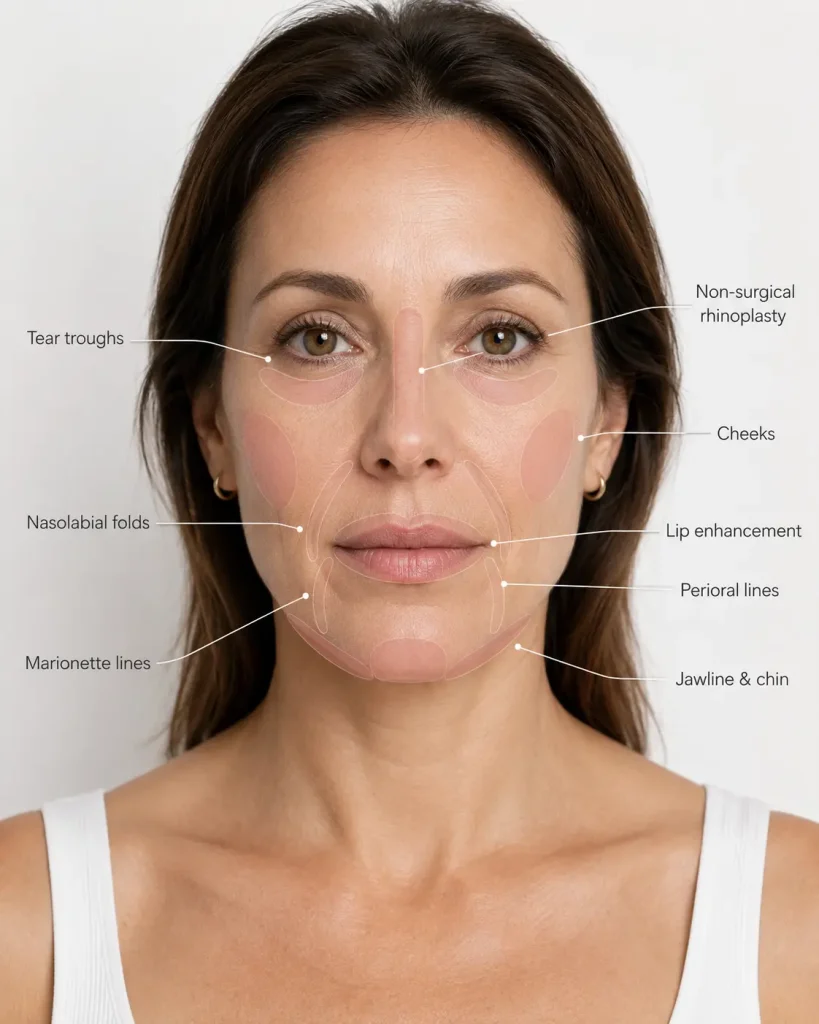
Primary Target Areas for Dermal Filler
Fillers excel at treating the mid-to-lower face where volume depletion is most noticeable:
-
Nasolabial Folds: The deep lines running from the sides of the nose down to the corners of the mouth.
-
Marionette Lines: Creases extending downward from the corners of the mouth toward the chin, creating a downturned appearance.
-
Lip Enhancement: Plumping thinning lips, defining the lip border, and smoothing vertical perioral smoke lines.
-
Structural Contouring: Restoring high volume to hollow cheeks, filling under-eye hollows (tear troughs), sharpening a weak jawline and chin or Non-surgical Rhinoplasty the 5 minute nose job.
Botox or Dermal Filler How Long Do Results Last?
While neither treatment is permanent, it does allow your aesthetic practitioner to continuously adjust your treatment plan to match your naturally changing facial structure over time.
-
Botox Duration: Results typically become visible within a few days, peaking at around 2 to 6 weeks. The muscle-relaxing effects generally last 3 to 4 months. As nerve signals gradually return, muscle movement recovers, and lines will slowly reappear, signaling it is time for a maintenance session.
-
Dermal Filler Duration: The plumping effect is immediate. Because Hyaluronic Acid is metabolised by the body slowly over time, results last anywhere from 6 months to 2 years.
The exact lifespan depends heavily on the thickness of the filler used and the movement level of the treated area (for example, lip fillers break down faster than cheek fillers due to constant talking and eating).
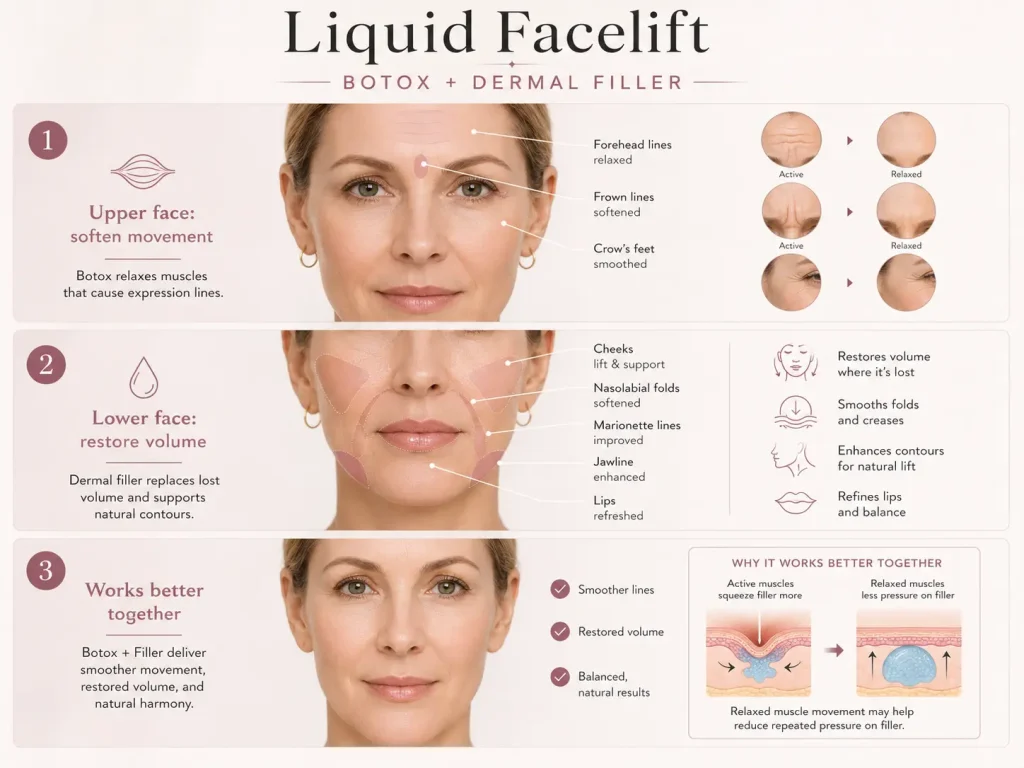
When used simultaneously, a strategy often referred to as a Liquid Facelift Botox or Dermal Filler can address facial ageing on multiple structural levels:
- Botox steps in to calm aggressive muscle movements in the upper face, smoothing expression lines.
- Dermal Fillers step in simultaneously to raise deep valleys, eliminate static shadow lines, and restore lost structural support in the lower face.
Using Botox or Dermal Filler in tandem can actually prolong your overall results; relaxing the muscles surrounding a dermal filler injection site reduces the continuous physical squeezing of the gel, helping the filler last noticeably longer.
How to Choose Your Next Step
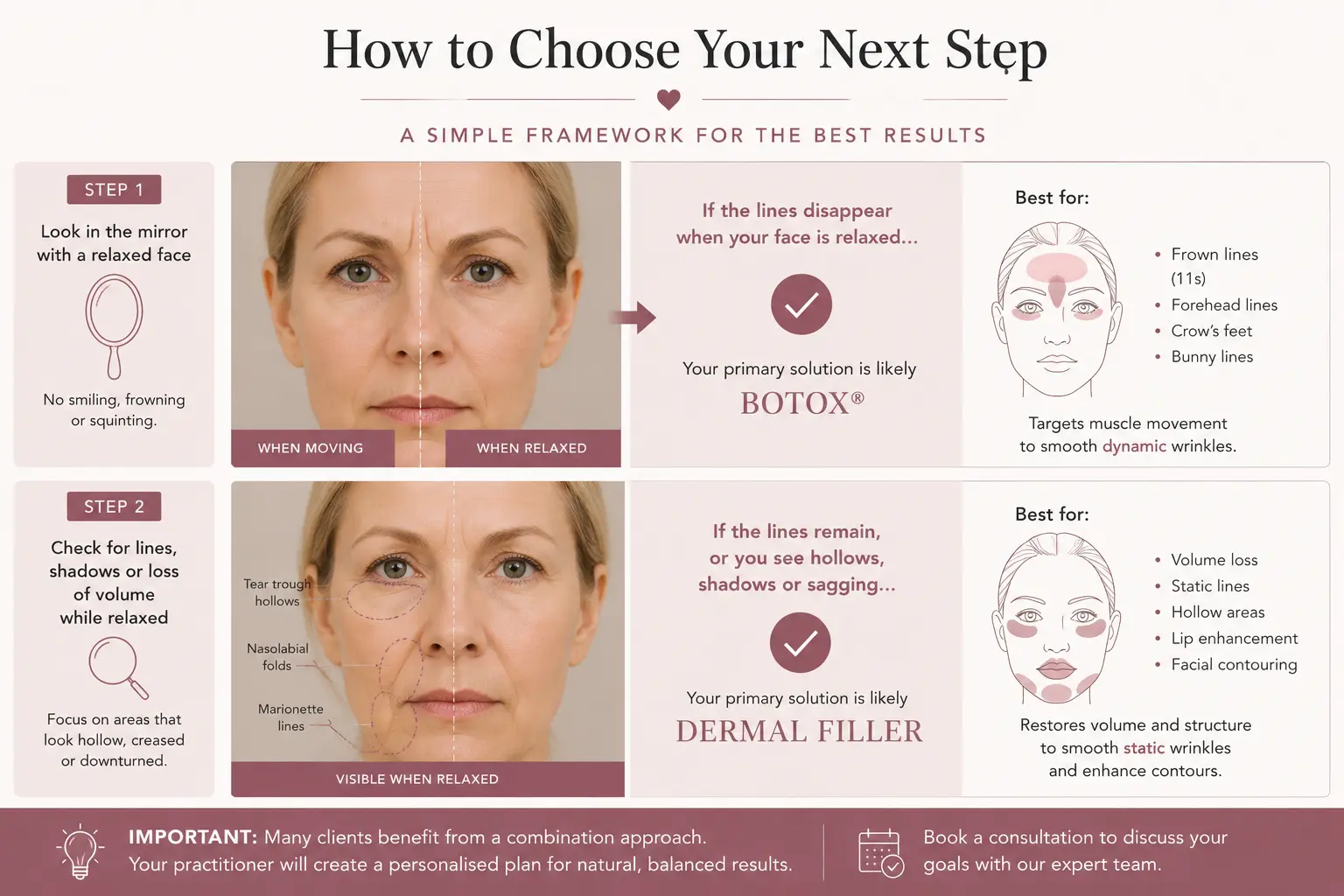
To determine the absolute best approach for your personal goals, use this simple framework:
-
Look closely in the mirror while keeping your face completely expressionless. If the lines that bother you disappear when your face is totally relaxed, your primary solution is likely Botox.
-
If the lines remain visible while your face is resting, or if you notice shadows, sagging skin, or areas that look hollowed out, your primary solution is likely Dermal Filler.
-
Schedule a comprehensive clinical consultation. Every face has completely unique underlying muscular anatomy and volume distribution.
-
Chloe Mackenzie, a highly qualified, accredited clinical aesthetics and aesthetics coomplications practitioner will conduct a thorough visual assessment of your tissue elasticity and movement to design a tailored, safe, and balanced treatment plan that delivers refreshed, beautifully natural results.
Frequently Asked Questions
Which is better for forehead wrinkles, Botox or Dermal Filler?
Botox is highly recommended for horizontal forehead lines. Forehead creases are dynamic wrinkles caused by regular muscle movement (raising the eyebrows), which means they are best treated by relaxing the muscle rather than plumping the skin with filler.
Can you get Botox or Dermal Filler at the same time?
Yes. Getting Botox and dermal fillers during the same clinical appointment is incredibly common and entirely safe. They target completely different layers of tissue and areas of the face to provide a balanced, non-surgical facial rejuvenation.
Are Dermal Fillers permanent?
No. Modern hyaluronic acid dermal fillers are entirely temporary and safely dissolve naturally into the body over 6 to 24 months. If necessary, hyaluronic acid fillers can also be reversed and dissolved instantly by a clinical practitioner using a specialized enzyme injection called hyaluronidase.
Which hurts more Botox or Dermal Filler?
Both treatments involve minimal discomfort. Botox uses an incredibly fine needle and feels like a brief, minor pinprick. Dermal fillers are placed slightly deeper, but the treatment gels are pre-blended with a local anaesthetic to thoroughly numb the area and ensure maximum patient comfort.