Insurance Guide For Beauticians
What is Beauty and Aesthetic Insurance?
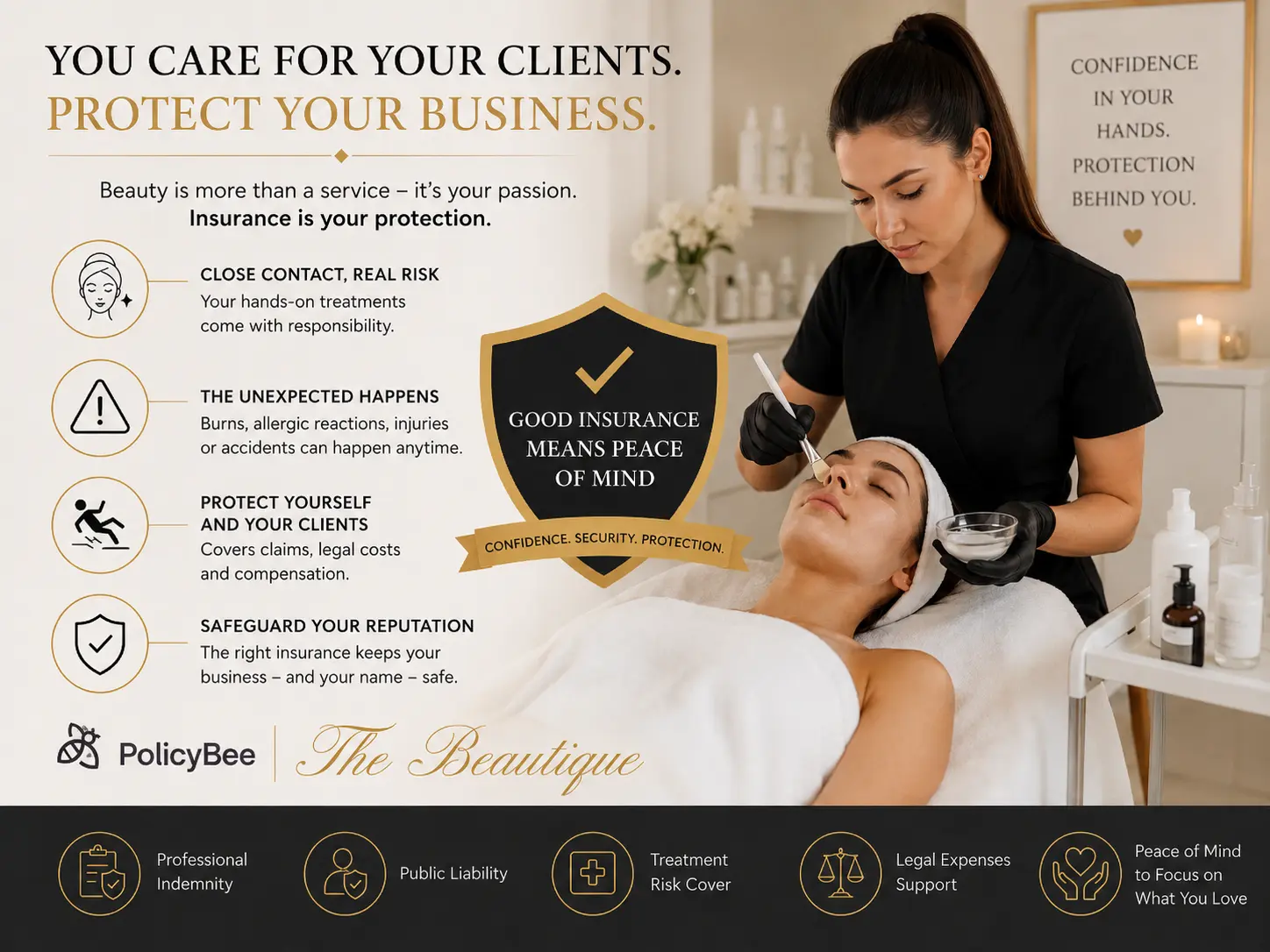
Answer Capsule: Beauty and aesthetic insurance is a tailored package of commercial policies designed to protect practitioners, clinics, and mobile therapists against financial liabilities. Subject to policy wording, limits, and exclusions, it may cover compensation claims, legal defense costs, and asset damage arising from client treatments, workplace injuries, or business property loss.

Insurance Guide For Beauticians
Understanding Key Liabilities Public, Professional, Treatment & Product
Understanding the distinct scope of each coverage type ensures you do not leave dangerous gaps in your protection.
1. Public Liability Insurance
Public liability addresses general accidental injury or third-party property damage not directly caused by the professional treatment itself.
-
Example: A client trips over an extension cord in your waiting area or spills coffee on an expensive client handbag.
2. Treatment Liability Insurance
Treatment liability specifically covers bodily injury, illness, or physical distress resulting directly from the performance of a procedure or therapy.
-
Example: A chemical peel causes unexpected skin scarring, or a laser treatment results in severe blistering.
3. Professional Indemnity Insurance
Professional indemnity protects against claims alleging breach of professional duty, bad advice, negligence, or failure of care that results in financial or emotional loss.
-
Example: A client claims financial loss due to a failed aesthetic consultation or alleges an aesthetic technique did not meet professional standards.
4. Product Liability Insurance
Product liability applies to adverse reactions or harm caused by products you sell, supply, or apply during a service.
-
Example: A client suffers a severe allergic reaction to a home-care serum sold at your reception desk or an eyelash glue applied during a treatment.
5. Employers’ Liability: When Is It Legally Required?
If you employ staff—including full-time, part-time, temporary workers, apprentices, or certain contractors—Employers’ Liability (EL) insurance is legally mandatory in the UK under the Employers’ Liability (Compulsory Insurance) Act 1969.
-
Legal Requirement: You must maintain a minimum of £5 million in EL coverage (most standard policies provide £10 million). Failure to hold compliant coverage can result in fines of up to £2,500 for every day you are uninsured.
-
Who Counts as an Employee? Even if workers are paid cash, are volunteers, or hold self-employed status for tax purposes, they may legally qualify as employees if you control their working hours, supply their equipment, and direct their day-to-day duties.
-
When It May Cover: Subject to terms and conditions, EL may cover legal fees and compensation costs if an employee suffers an injury or illness arising out of their work (e.g., repetitive strain injury, severe dermatitis from salon chemicals, or a burn from equipment).
Tailoring Coverage to Your Practice Setup
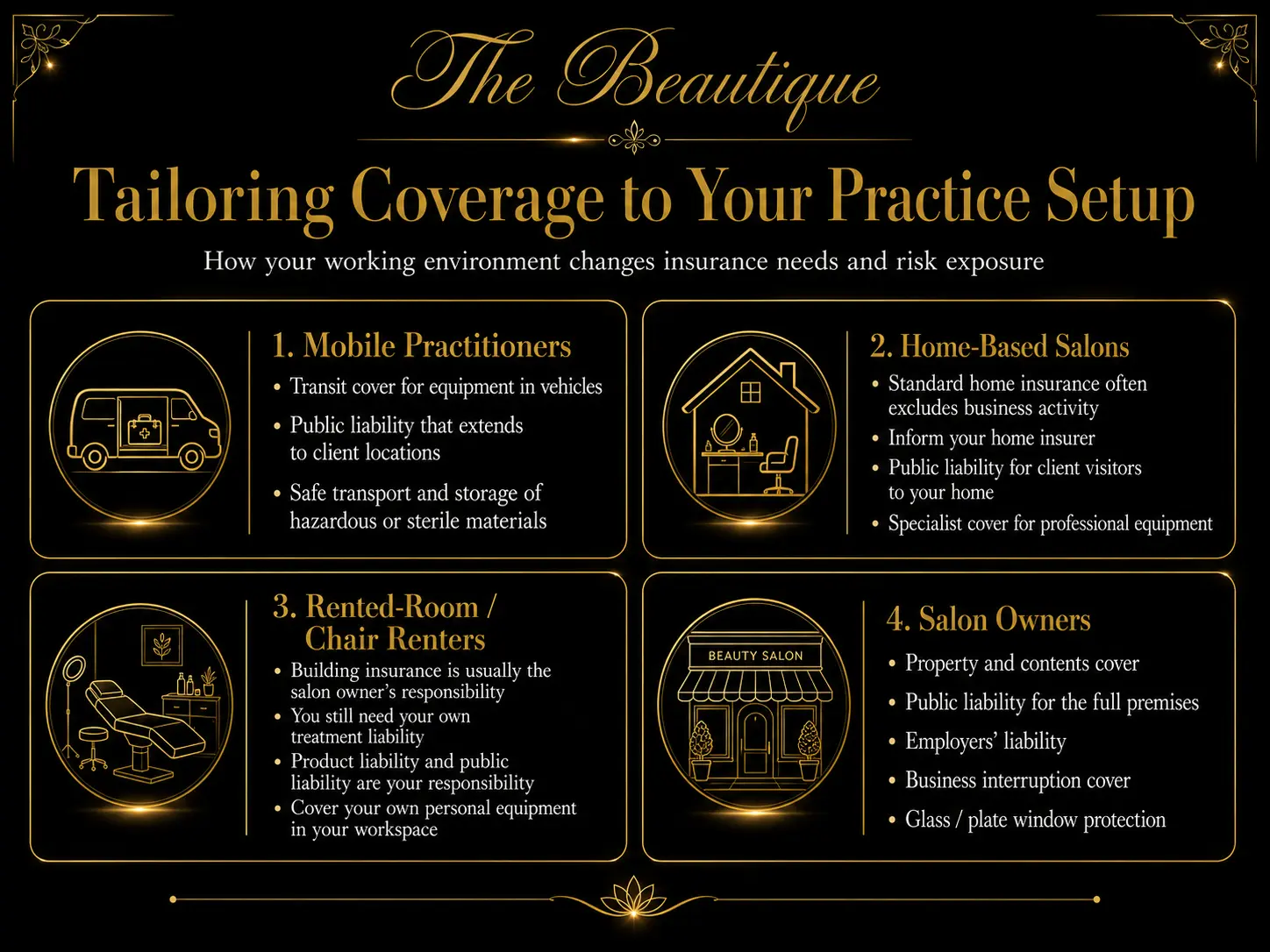
Your physical operating setup alters your legal exposure and property risks:
-
Mobile Practitioners: Requires transit cover for equipment in vehicles, public liability extending to client locations, and strict guidelines regarding safe transport and storage of hazardous or sterile materials.
-
Home-Based Salons: Standard domestic home insurance usually excludes business activities. You must inform your home insurer and secure commercial public liability that covers client visitors to your home premises, along with specialized equipment cover.
-
Rented-Room / Chair Renters: While the salon owner maintains building insurance, you are individually responsible for your own treatment liability, product liability, personal equipment, and public liability within your designated workspace.
-
Salon Owners: Requires comprehensive property and contents cover, public liability for the entire premises, employers' liability, business interruption, and glass/plate window protection.
Checking That Every Treatment Is Explicitly Covered
Never assume a blanket "beauty therapy" policy covers every procedure in your service menu. Insurance underwriters require explicit endorsement for specific modalities, especially advanced aesthetic procedures.
How to Ensure Full Treatment Endorsement:
-
Submit Your Qualifications: Insurers require accredited certificates for every treatment you offer.
-
Review the Endorsement List: Check your schedule of insurance to confirm that specialized treatments (e.g., microneedling, fat cavitation, lipo dissolving, IPL/Laser, or injectable fillers) are explicitly named.
-
Comply with Pre-Requisites & Patch Testing: Failure to follow mandatory patch-testing protocols or client consultation requirements outlined in your policy schedule can void your cover for that claim.
-
Notify Insurers of New Services: Before launching a new treatment or upgrading machinery, confirm with your broker that your policy covers the specific make, model, and medical grade of the equipment.
Policy Exclusions and Claims-Notification Guidance
Common Exclusions to Watch For
Policies vary, but common exclusions where claims may be refused include:
-
Performing treatments without holding a recognized, insurer-approved qualification.
-
Failing to adhere strictly to manufacturer instructions or required patch-testing lead times.
-
Unauthorized off-label use of regulated aesthetic products or prescription-only medicines (POMs).
-
Intentional misconduct, deliberate omission, or working outside your legal scope of practice.
Claims-Notification Rules
If a client expresses dissatisfaction, threatens legal action, or suffers an adverse event:
-
Report Immediately: Notify your broker or insurer as soon as an incident occurs—even if a formal claim has not yet been filed. Late notification is a frequent reason insurers deny cover.
-
Do Not Admit Fault: Express empathy, but do not apologize in a way that accepts legal liability, offer refunds, or promise compensation without prior written consent from your insurer.
-
Preserve Documentation: Retain signed consultation forms, medical history logs, batch numbers, consent records, and clear photograph series.
Provider Recommendation & Referral Disclosure
Recommended Insurance Partner: PolicyBee
When evaluating providers for specialised beauty, holistic, and aesthetic insurance, PolicyBee offers tailored cover options designed specifically for independent practitioners and growing salons.
Depending on your selections, a combined policy through PolicyBee may cover legal defense fees, compensation awards, and contents replacement, subject to the individual policy wording, limits, and exclusions.
Types of Insurance Every Beauty Professional Should Have
Whether you’re running your own salon, renting a chair, or offering mobile services, there are several key types of insurance coverage you should consider:
Public Liability Insurance
This is often the most essential policy for anyone in the beauty industry. It covers you if a client or member of the public is injured in your salon or by your equipment. For example, if a client trips over a cord or suffers a burn from a tool, public liability covers medical costs, legal fees, and compensation.
Professional Indemnity Insurance
This protects against claims that your advice, service, or treatment caused harm or didn't deliver the promised results. If a client sues over a facial treatment that caused breakouts, or an aesthetic procedure that led to complications, this insurance is your financial shield.
Product Liability Coverage
Many beauticians use and sell cosmetic products. Even if you’re not the manufacturer, you could still be liable if a client reacts badly to a cream or serum you applied or recommended. Product liability coverage steps in to handle claims and protect your reputation.
Business Equipment and Property Insurance
Your tools and machines are your livelihood. Whether you use LED therapy machines, microneedling pens, IPL devices, Fat Cavitation, or simply high-end scissors and styling tools, any damage, theft, or fire can be financially devastating. Insurance helps cover the cost of replacements and business interruption.

The Benefits of Comprehensive Insurance
Peace of Mind and Client Confidence
When clients know you’re fully insured, it signals professionalism and care. It gives them reassurance that, in the rare event something goes wrong, they’re protected—and so are you. This peace of mind makes clients more likely to return and refer others.
Insurance Guide for Beauty and Aesthetic Professionals
Provides Financial Protection from Claims
One lawsuit, even one you win can cost you in legal fees, time, and stress. With good insurance, those costs are covered. Compensation claims, out-of-court settlements, and even reputational recovery services may be included in a well-rounded policy.
Insurance for Beauticians
Essential protection by covering liability claims, treatment accidents, and equipment loss, helping build client trust and ensuring peace of mind.
The Beautique Beauty Academy is a premier training centre dedicated to empowering aspiring beauty professionals with top-tier education and hands-on experience. Combing the latest techniques with real-world skills preparing students for a successful career in the beauty industry. #5#
Insurance Guide for Beauty and Aesthetic Professionals
Commercial Relationship Disclosure
-
Referral Disclosure: The Beautique maintains an affiliate/referral arrangement with PolicyBee. If you click through our link or purchase a policy via our recommendation, The Beautique may receive a referral fee or commission at no additional cost to you. We encourage all professionals to evaluate their individual coverage requirements against the checklist above before purchasing any insurance policy.