
Botox vs Dermal fillers in Norfolk – Are you thinking which is the best suited to my needs because the treatment names sound interchangeable while the outcomes are not. The hard truth is simple: Botox treats muscle-driven lines, while dermal fillers restore volume and structure, so the right choice starts with the cause of the concern, not the popularity of the procedure.
- Botox targets muscle-driven lines, ideal for dynamic wrinkles.
- Fillers restore volume and structure, best for static lines and contouring.
- Choose Botox for expression-related concerns; opt for fillers for volume loss.
- Both treatments can complement each other in a tailored plan.
Botox treats movement; fillers treat volume
Botox vs Dermal fillers in Norfolk – the core difference is anatomical. Botox temporarily relaxes targeted muscles that create expression lines, while hyaluronic acid fillers add volume, hydration, shape, or structural support. One reduces movement. The other replaces or enhances fullness. Choosing by treatment name rather than facial concern is where most poor decisions begin.
| Decision point | Botox | Dermal fillers |
|---|---|---|
| Main purpose | Relaxes muscles to smooth wrinkles | Adds volume, restores structure, enhances features |
| Best suited to | Dynamic lines caused by movement | Static lines, volume loss, contouring, lip enhancement |
| Results visible | Gradually within 3 to 14 days | Immediately, settling over 1 to 2 weeks |
| Typical duration | Around 3 to 4 months | Around 6 to 12 months |
| Starting price | From £170 | From £175 |
| Reversibility | Effects fade naturally | Hyaluronic acid filler can be dissolved with hyaluronidase |
- Movement problem: discuss Botox.
- Volume or structure problem: discuss dermal filler.
- Both concerns: consider a treatment plan in which each product has a separate purpose.
Practical rule: If the line appears mainly when you frown, smile, squint, or raise your brows, start by discussing Botox. If the concern is present at rest because volume or support is missing, discuss filler.
Botox vs Dermal Fillers in Norfolk – Choose Botox when the line is caused by expression
Botox is usually the stronger fit for forehead lines, frown lines, crow’s feet, bunny lines, chin dimpling, jawline slimming, and platysmal neck bands. It blocks nerve signals that trigger muscle contraction, allowing the skin above the treated muscle to look smoother while movement gradually returns over time. This makes Botox particularly effective for addressing lines that appear with facial movements, while fillers are more suitable for static lines that are present even at rest.
- Upper face: forehead lines, frown lines, and crow’s feet.
- Mid face: bunny lines, nose-related concerns, and the masseter muscle.
- Lower face: chin dimpling and jawline slimming.
- Neck: platysmal bands.
- Additional uses: teeth grinding, jaw clenching, excessive sweating, chronic migraines, and headaches.
The practical benefit is control rather than volume. Botox does not fill a fold, enlarge a lip, or project a chin. It reduces the repeated muscular pull behind dynamic wrinkles and can also be used preventatively before those lines become more established.
Botox vs Dermal Fillers in Norfolk – Choose fillers when volume, shape, or support is missing
Dermal fillers are the better solution for lip enhancement, cheek volume, jawline definition, chin reshaping, nasolabial folds, marionette lines, under-eye hollows, and non-surgical nose reshaping. They use hyaluronic acid to attract water, add fullness, restore support, and refine facial balance without changing muscle movement.
- Restore volume: cheeks, lips, temples, and hollow areas.
- Soften folds: nasolabial folds, marionette lines, and vertical lip lines.
- Improve definition: jawline, chin, and facial contours.
- Support lift: cheeks, jowls, and areas affected by sagging.
- Refine proportions: nose shape, lip shape, symmetry, and overall facial balance.
Fillers are ideal when you want to enhance facial contours, restore lost volume, or improve the overall shape of your features without affecting muscle movement.
Fillers are not a generic gel used identically everywhere. The source material identifies Teoxane RHA4 for deeper wrinkles and volume, Juvederm for applications ranging from subtle lip enhancement to facial contouring, and Stylage for lips, folds, hydration, and gentler volume restoration.
To make this easier, use the Facial Feature Enhancer Quiz below.
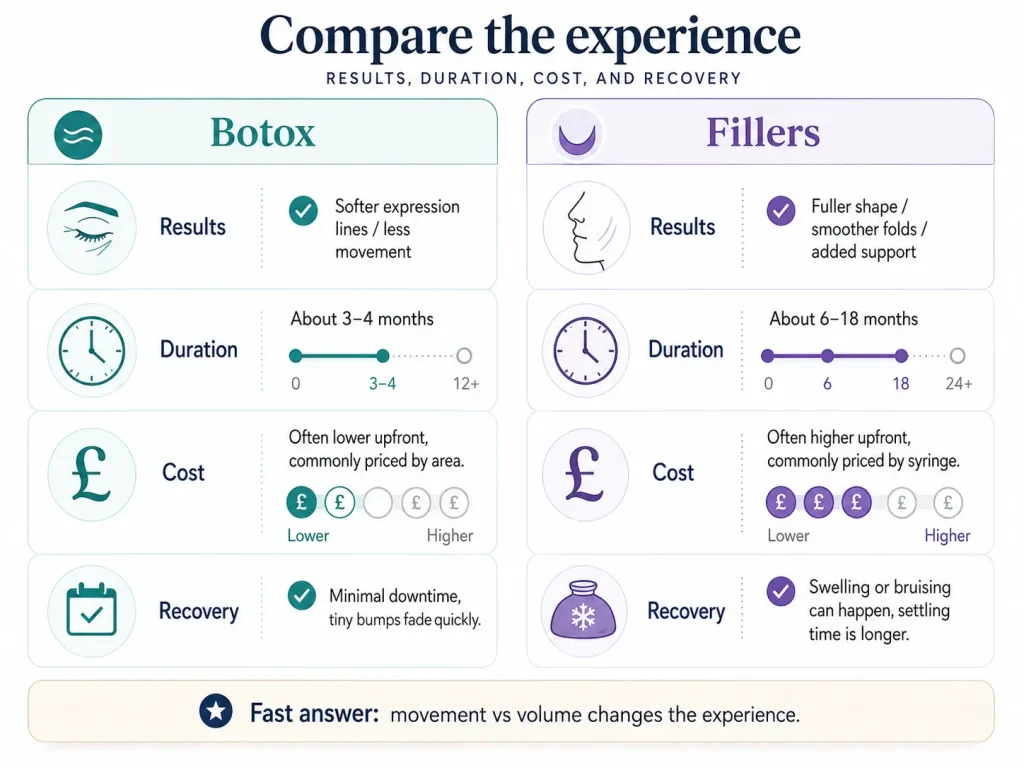
Botox vs Dermal fillers in Norfolk – Results, duration, Cost & Recovery
The treatments differ most clearly in how quickly results appear, how long they last, and what recovery looks like. Understanding the differences in results and how long they last can help you make an informed decision about which treatment aligns with your aesthetic goals. Botox develops gradually over 3 to 14 days and lasts around 3 to 4 months. Filler is visible immediately, settles over 1 to 2 weeks, and typically lasts 6 to 12 months.
What Botox timing means in practice
Botox vs Dermal Fillers in Norfolk – Botox is not an instant-result treatment. The treated muscles relax progressively, so visible changes develop over 3 to 14 days. Mild redness or swelling may last a few hours. Results then hold for roughly 3 to 4 months before muscle movement gradually returns and another treatment may be considered.
- Immediately after treatment: expect a quick pinprick sensation and possible short-lived redness or swelling.
- First 24 hours: avoid lying flat, strenuous exercise, alcohol, and saunas.
- First two weeks: allow the result to develop rather than judging it on day one.
- Maintenance point: review treatment as movement returns, not simply because a calendar date has arrived.
Workflow note: Do not assess Botox as though it were filler. An immediate mirror check tells you very little because the intended effect develops gradually rather than appearing at the moment of injection.
What filler settling means in practice
Botox vs Dermal Fillers – Filler gives an immediate change, but the first view is not the final result. Swelling, bruising, tenderness, and temporary firmness can alter the appearance during the first days. The source advises allowing 1 to 2 weeks for the product to settle and integrate before making a final judgement.
- First 12 hours: an ice pack may be applied for 15 minutes every hour to ease swelling.
- First 24 to 48 hours: avoid heat, alcohol, and strenuous exercise.
- Lip filler: temporary firmness can occur before the filler softens into the lip tissue.
- Typical longevity: expect around 6 to 12 months, depending on product, area, and individual metabolism.
Pricing is close at entry level, with Botox starting from £110 and fillers from £100 at The Beautique Aesthetics Clinic. That near-equal starting price is misleading if treated as a direct comparison. Botox pricing varies by treated areas. Filler pricing varies by product grade and required millilitres.
Side effects, reversibility, and practitioner choice
Both treatments commonly cause temporary injection-site reactions, but their risk profiles are not identical. Botox is associated with redness, swelling, bruising, headache, and rare temporary drooping. Fillers commonly cause swelling, bruising, redness, and tenderness, with rare but more serious complications including infection or vascular occlusion.
Botox side effects are usually short-lived
Most Botox side effects described in the source are minor and temporary. Redness, swelling, bruising, and a mild headache can occur after treatment. Temporary drooping is listed as rare. The sensible response is not to pretend injectables are risk-free, but to follow aftercare and use an experienced practitioner.
- Common effects: local redness, swelling, and bruising.
- Possible short-term effect: a mild headache.
- Rare effect: temporary drooping.
- Comfort: treatment is usually described as a mild pinprick, with numbing available if needed.
Filler risk makes clinical judgement essential
Filler is generally well tolerated, especially because many products contain lidocaine and numbing cream is commonly applied first. Still, the risk discussion must include more than bruising. The source specifically names infection and vascular occlusion as rare serious complications, making practitioner qualification and experience a central decision factor.
- Expected reactions: swelling, bruising, redness, tenderness, pressure, or brief stinging.
- Rare serious risks: infection and vascular occlusion.
- Reversibility: hyaluronic acid filler can be dissolved with hyaluronidase.
- Risk reduction: choose a qualified, experienced professional and follow the supplied aftercare manual.
Practical rule: A lower price is not a meaningful advantage if it comes with weaker assessment, poor product selection, or inadequate complication management. The treatment plan and the practitioner matter more than a small difference in starting cost.
Age is not the main decision variable
There is no single correct age for either treatment. The more useful question is what you are trying to change. Botox may be used in the late twenties to reduce repeated muscle-driven lines or later to soften established wrinkles. Fillers may enhance younger features or restore age-related volume loss.
Preventative and corrective Botox serve different goals
Some clients begin Botox in their late twenties to reduce the repeated movement that contributes to wrinkle formation. Others wait until their thirties or forties to soften lines that are already visible. Neither route is automatically superior. The relevant variables are muscle activity, line depth, personal goals, and practitioner assessment.
Preventative use is common, but it should not become treatment by habit. The source makes no claim that everyone needs to start at a particular age. A consultation should establish whether the concern is dynamic, whether treatment is appropriate, and how much movement the client wants to retain.
Fillers change purpose across age groups
Younger clients may use filler to enhance lips, define a jawline, reshape a chin, or refine facial proportions. Older clients may use it to replace cheek or temple volume, soften folds, or support areas affected by sagging. The product may be similar, but the treatment objective is not.
- Enhancement-led treatment: focuses on shape, symmetry, definition, or hydration.
- Restoration-led treatment: focuses on lost volume, deeper folds, hollows, or reduced support.
- Planning requirement: choose product type, placement, and amount around the desired outcome rather than age alone.
When Botox and fillers work better together
Botox and fillers can be used in the same treatment plan because they address different causes of facial ageing. Botox can soften forehead movement while filler restores cheek or lip volume. This is not duplication. It is a combined approach to dynamic wrinkles, static folds, structural change, and feature enhancement.
Combined treatment needs separate objectives
A combined plan works best when each product has a defined job. For example, Botox may reduce forehead or frown-line movement while filler adds volume to the cheeks or lips. The mistake is treating the whole face with one product because it is familiar, fashionable, or easier to explain. When considering both options, it’s essential to have a clear treatment plan that addresses each concern distinctly to achieve the best overall results.
- Use Botox for: movement-led wrinkles and selected muscle-related concerns.
- Use filler for: lost volume, deeper folds, contour, hydration, and structural support.
- Use both for: a plan that needs muscle relaxation and volume restoration in separate areas.
- Keep the result natural: define the purpose of every injection before deciding the amount.
Workflow note: Combination treatment is not automatically better. It is justified only when the assessment identifies both muscle-driven lines and a genuine need for volume, contour, hydration, or structural support.
The Botox vs filler decision framework
Neither treatment is universally better. Botox is better for movement. Filler is better for volume and structure. The final choice should account for the facial concern, desired result, treatment area, expected longevity, recovery, risk profile, and whether a single treatment or a combined plan is appropriate.
- Choose Botox when: lines deepen with facial expression, the masseter is enlarged or tense, platysmal bands are visible, or muscle activity is the main cause.
- Choose filler when: the concern is volume loss, lip shape, cheek support, static folds, chin or jawline definition, hydration, or facial balance.
- Consider both when: dynamic lines and volume loss exist in different areas and each treatment has a separate objective.
- Pause and consult when: you are choosing by trend, price alone, or a treatment name rather than the cause of the concern.
Botox vs filler FAQs
The most useful FAQs focus on specific anatomy rather than broad claims about which injectable is superior. Forehead lines usually point towards Botox, treatment longevity differs substantially, and jawline filler should not be confused with masseter Botox. They may affect a similar region, but they work through completely different mechanisms.
What are the main differences in how Botox and fillers work? Botox works by temporarily paralyzing muscles to reduce the appearance of wrinkles, while fillers add volume to areas of the face to restore fullness and smooth out lines.
Is Botox or filler better for forehead lines?
Botox is usually more effective for forehead lines because those lines are commonly caused by repeated muscle movement. By relaxing the targeted muscles, Botox reduces the movement that creases the skin. Filler is designed to add volume or structure, so it is not the default treatment for a movement-led forehead concern.
How long do Botox and fillers last?
Botox results usually last around 3 to 4 months, while dermal fillers typically last around 6 to 12 months. Filler longevity varies with treatment area, product, and individual metabolism. Botox wears off as muscle movement returns. Neither treatment is permanent, so both may require maintenance over time.
What is the difference between jawline filler and masseter Botox?
Jawline filler adds definition, shape, and structural support along the jaw. Masseter Botox works differently by relaxing enlarged jaw muscles, which may slim the lower face and reduce tension linked with clenching or grinding. One adds structure. The other reduces muscle activity. They should not be treated as interchangeable.
The final verdict is straightforward: choose the treatment that matches the cause. Botox is the stronger option for dynamic, muscle-driven lines. Dermal filler is the stronger option for volume loss, contour, hydration, and static folds. Similar needles do not mean similar treatments.
Book a consultation with Chloe Mackenzie at The Beautique Aesthetics Clinic to assess your facial movement, volume, structure, goals, and tolerance for maintenance. The clinic offers Botox anti-wrinkle treatments from £110 and dermal fillers from £100, with same-day or separate-day filler consultations available if you want more time before deciding.
Key statistics
- Botox treatment effects typically begin within 1 to 3 days and last approximately 3 to 4 months. (Mayo Clinic)
- Hyaluronic acid dermal fillers typically retain their results for about 6 to 12 months. (Mayo Clinic)
- Most patients experience Botox effects lasting at least 3 months and often up to 4–5 months depending on area, dose, and formulation. (PubMed review of botulinum toxin duration)
- Dermatologists report hyaluronic acid gel fillers last between 4 to 12 months, while calcium hydroxylapatite fillers last 6 months to 1 year. (American Academy of Dermatology (AAD))
- Botox remains the most popular minimally invasive cosmetic procedure in the U.S., with nearly 9.5 million procedures performed in 2023. (American Society of Plastic Surgeons (ASPS))